


C. came to me after 10 years at the same company.
Ten years with the same employer. She did the work of a team with occasional support from contractors. C. was underpaid, undersupported, and convinced she wasn’t competitive outside of a company she once enjoyed working at.
That last part — the “I’m not competitive” belief — was doing the most damage. I challenged her on the supporting evidence. She was drained by the wear and tear of a decade of being told, in small ways, that her value was situational. C. became used to the company’s ways of working, stopped prioritizing her growth, and lost track of trends in her industry.
She was a one-woman show because she absorbed work that wasn’t resourced, picked up the slack for poorly planned timelines, and felt pressure to deliver.
The problem
When we started working together, she couldn’t articulate what she’d built. C. was always in reactive mode and lacking the time and energy to assess and celebrate her achievements.
We talked through the work she did, and I probed about the results. There was evidence, and I encouraged C. to gather data that said: I did this, it went from X to Y, and the company benefited by Z.
And the job search she’d been running, quietly, on the side, was going nowhere. She was applying to roles and getting silence back. Not because she wasn’t qualified. Because her application didn’t show her.
There was something else. Whenever she said she was stretched, or that a new project felt outside her bandwidth, someone in leadership would say, “We’ll get you more support” and then not follow through. She got used to going along until she passed her breaking point.
The pursuit
Once C. pulled together her work, I helped direct her narrative. She was proactive in leveraging AI to improve her resume and summarize her results. We discussed coping strategies for her to deal with work stress while she conducted her job search.
The dog-walk ritual came from her. At the end of the day she closed her laptop, and C. walked her dog to signal the end of work. She told me it was the only time in the day that felt like hers.
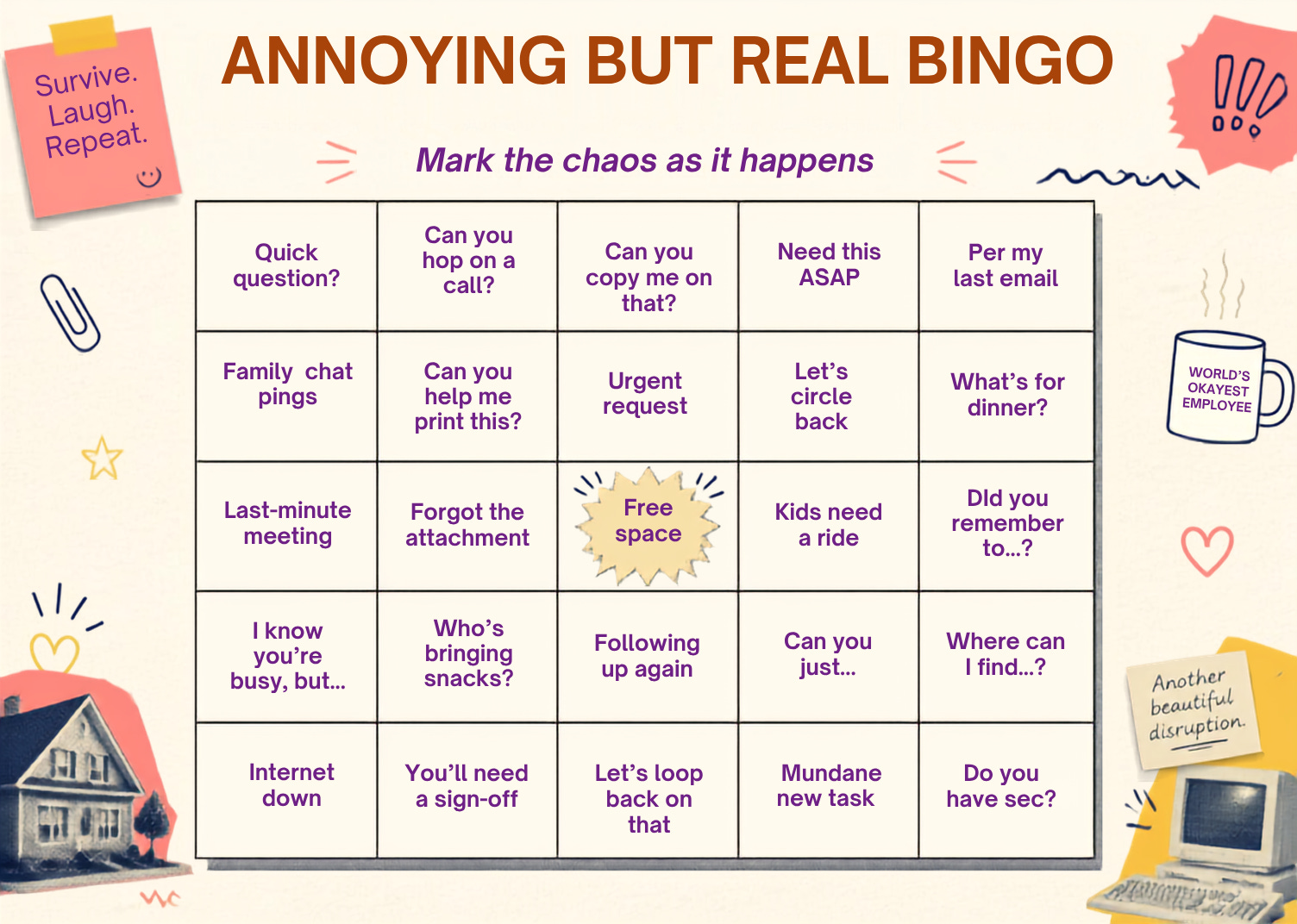
She also started a bingo card (sample below). A private document where she logged office absurdities: the commitment that didn’t land, the meeting that was a re-run of the meeting before it, the “we’ll loop you in” that never happened. It wasn’t a venting exercise. It was a reality check and a reminder that the situation wasn’t permanent.
And when someone in leadership came to her with a new request, she stopped saying yes or no immediately. She said: “Let me look at my plate and come back to you.” She stopped absorbing on instinct and started choosing.
The payoff
C’s not done with her job search.
The payoff is that she’s different now. She walks into conversations at her company with a new mentality. She knows what she built, can say it out loud, and has set boundaries.
The one-woman show is exhausting. A workplace that makes you feel like you’re holding it together needs you more than you need it.