


I was handed a $100 million pledge to fight racial injustice and told to get it started.
No playbook. 10 teams to activate. That was Peloton.
I got to that moment because I was passionate about equity and inclusion, I had a strong project management track record, it was 2020, and I had a referral.
This is an example of how I leveraged my Power Position. Today at noon, I walked Boston University alumni through the whole framework. This is the written version, because I want you to be able to shape your career story.
“Venn diagrams never rocked my world so hard.” - BU alum participant
The three circles
What you love. What you’ve proven you can do. What the market will pay for.
Your Power Position is the overlap.
Passion without market demand is a hobby. Market demand without proven skills is a job you can’t qualify for. Proven skills without interest is how you end up burned out and dreading Monday mornings.
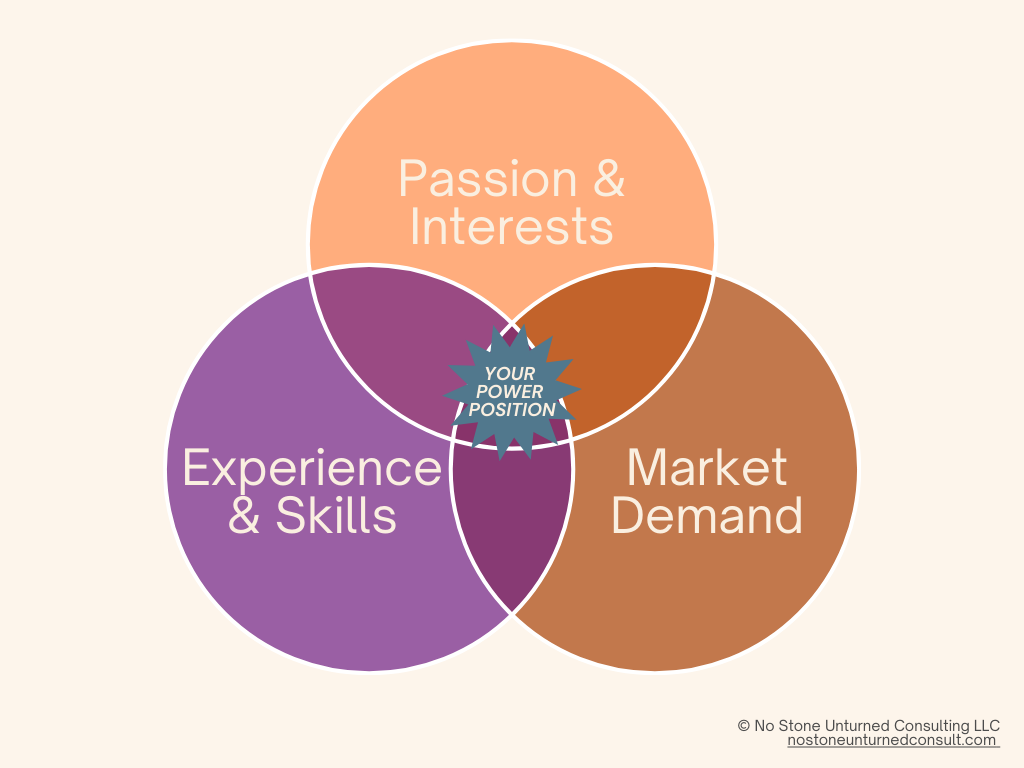
The part the diagrams leave out
These aren’t three fixed circles, one sweet spot, congratulations, you’re done.
Mine move and so do yours.
Market demand can be erratic and doesn’t care about your 5-year plan. Your skills compound whether or not you’re tracking them, which is why most people are underselling work they did 3 years ago. And your interests shift, maybe before you even notice it.
So the useful question is which circle moved since you last looked.
Four times, same math
PBS—> Guggenheim Arts Foundation—> Planned Parenthood. I started out wanting to tell stories that expanded access and equity to information and services. That’s where my passion circle was, and I followed it first, which is what a lot of people do.
Grad school. I want to create impact at a global level, and my skills circle was the thing standing in the way. So I grew that one intentionally. Deliberately, expensively, over 2 years.
Global health. A $200M+ USAID health portfolio at JSI across 5 countries. Abt’s first project in Afghanistan, stood up from nothing. JSI’s first international subsidiary in India. By the end of that stretch, I ran complex programs in places where the operating context fluctuated due to government changes and security issues.
Tech. I took the program management muscle I’d built in global health and moved it into a sector that priced it completely differently, while maintaining the same throughline.
I wasn’t doing anything wildly different between global health and tech. Rather, it was the demand for what I did.
What it costs to check late
A woman in her 40s wrote this on a forum in March:
“I’m fearful there is a giant values misalignment and that I’m wasting my life in exchange for a big paycheck that may or may not be worth it.”
She’s describing a job sitting at the intersection of market demand and skills, and has drifted out of what she loves.
The reason it feels like a crisis is that she’s been asked, probably by everyone including herself, what do you want? That’s the wrong level of question. It’s too big to answer on any given Tuesday, and failing to answer it makes her feel like something is wrong with her.
Which circle has shifted? That’s a question you break down and answer.
Where to start
Skills and experience first: It’s the only circle you can inventory without guessing. Pull the last 3 years of your work. Write down what you built, what changed because you built it, and what you’d charge someone to do it again.
Market demand: Use AI to analyze 20 job descriptions in the direction you’re curious about. Not to apply. To see what language the market is using right now for the thing you already know how to do. The gap between their words and yours is helpful intel.
Interests: What you enjoyed at 28 has shifted. What you find yourself reading about at 11pm, when nobody is prompting you, that’s something to dig into.
I built a 15-question diagnostic that runs all three. It takes about 20 minutes, and it’s the part you can do without me. Download it here.
If the answers make you uncomfortable, that usually means it worked.
Let me know where you’re finding the most resistance.