

A woman in her 40s posted this in April:
“I feel like a loser, and it is really hard to regain hope on some days. My self-confidence is shrinking.”
She’d lost a relationship and a job in the same stretch. Everything else in her post was a plain, unemotional description of two hard years, and then this one evaluative word sitting in the middle of it.
A few lines later she explained where it came from:
“A younger version of myself thought I would be in a different life chapter at this time.”
That type of thinking is a trap. We’ve been conditioned to think of life milestones as fixed destination points that we need to hit at the right time (+/-), when, in reality, there’s more fluidity and nuance to them.
Decisions become our plans
Part of the plan breaks down after college. You’re supposed to find a job or go to grad school. But what if you still don’t know what you want to do?
My aunt worked for PBS/WETA, and there was a post-grad internship. I went from being a PR major to a TV production intern.
I wasn’t worried about my 401k, owning a house, a future partner, or my career trajectory. I made enough to cover my expenses and didn’t even have to deal with roommates (amazing since I shared a room and lived with 5 other women in college).
In your 20s, what was informing your decision-making? Decision after decision kind of turns into a plan.
For a few years, I experimented with freelance TV production, an arts foundation, a PR internship, and took a couple of existential travel breaks. In 2007, I landed a job that I constantly cite as transformative at Planned Parenthood. I was in my mid-20s and not on a clear fast-track, but I felt that I was finding my way.
What 15 years of program management taught me about this
In program management, you start with a kickoff meeting. You share the vision, scope, budget, and staffing. Incomplete information results in assumptions.
You write them down so you can go back and check them when reality delivers new data. This is a learning process.
What informed your assumptions?
Why did the inputs, results, etc. vary?
What were the impacts of the changes?
We don’t generally apply this type of analytical thinking with our own lives. The 28-year-old’s plan gets treated as a commitment. We keep climbing, become more risk-averse, and 15 years of new information doesn’t always factor into us revising our life plans.
The overreaction question
From coaching clients, social posts, and networking events, I hear:
“40s, ‘good on paper’ job, but it’s a bad fit. Am I going through a midlife crisis?”
Something must be wrong if we aren’t following the socially constructed “plan,” right? There must be some serious consequence for not being a VP by 40, married with a mortgage and 2.5 children. And there is, it’s self-doubt, judgment, disappointment, and the list goes on.
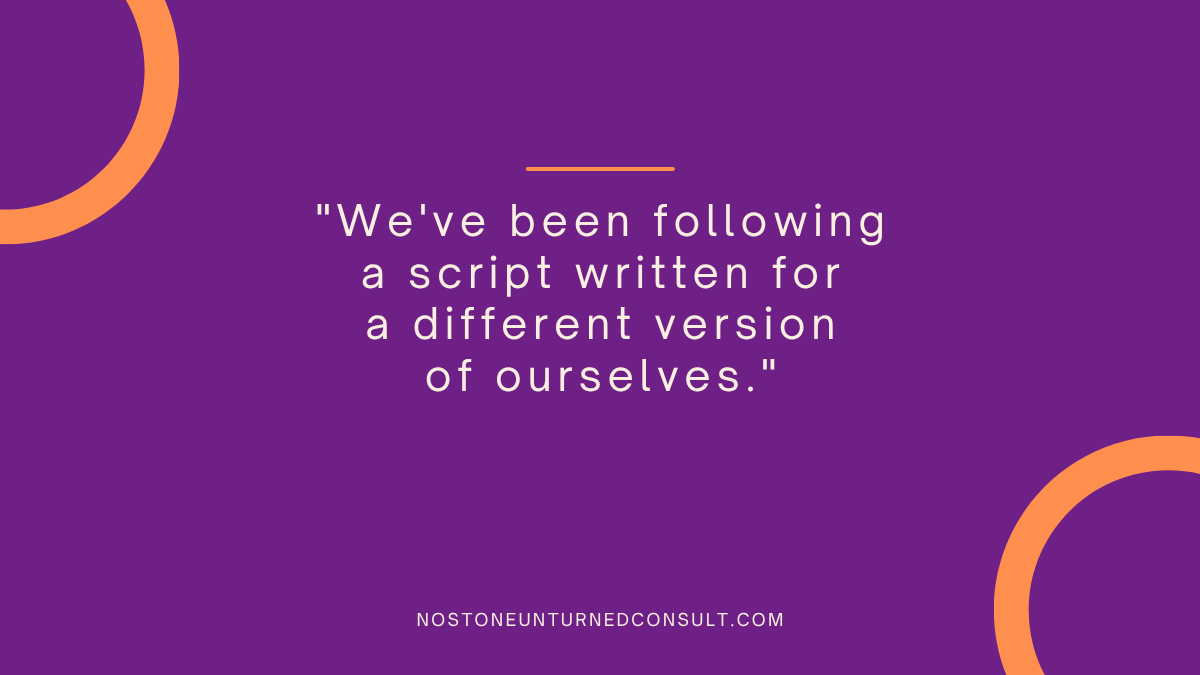
What if we reframe this as a midlife assessment? We’ve been following a script that was written for a different version of ourselves. We’ve grown, our interests have changed, and/or we want different things.
The loop we can’t escape
“I feel like I am just stuck on this hamster wheel of trying to become the perfect woman.”
It’s a loop that we can’t escape. We think about what we’re lacking: another certification, a 5am morning routine, a partner, or a better wardrobe.
It’s the comparison game, feeling behind our peers. Maybe you did all of the “right” things—a first marriage, a master’s degree—and yet, the result you were promised never showed up.
Before you go into self-flagellation mode, ask yourself: How can you fairly judge where you are in your specific existence against a universal schedule?
The exercise
Pull the plan out and look at it directly.
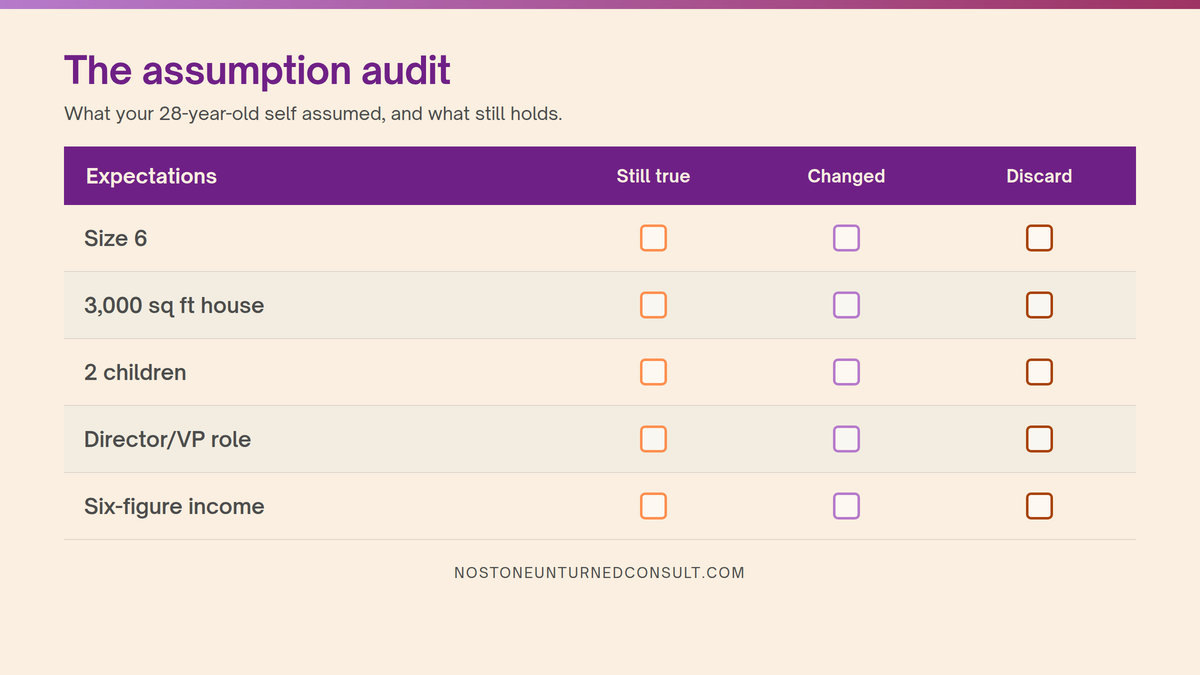
Write down what your 28-year-old self assumed. Be specific and generous with her, because she was working with what she had. She assumed things about your industry, earning potential, health, family structure, and what you wanted by now.
Next to each item, mark: still true, changed, or discard. Mock up below.
What surprises you about your answers?
What was hard to let go of?
What felt liberating to discard?
What’s your thing?
“Does anyone else not have a ‘thing’?”
I get asked this a lot. The premise is that other people were issued a single organizing passion and you might have received the short end of the stick.
I believe everyone has at least one ‘thing.’ You show up in a way that no one else does. People continuously come to you for it. When you talk about it, a smile pops up on your face.
Drop yours in the comments.
If you want someone who’ll take the plan apart with you, schedule a free 30-minute discovery call with me.