


You did the work. You took the role, then the next one, then the one after that. You learned, increased your earnings, and built a career that looks, on paper, like a career that’s going somewhere.
And here you are. Successful by external measures. Yet, you’re asking, what’s next? Or is what you have it?
If you’re sitting with these thoughts, you aren’t alone.
I coach mid-career women through this exact moment, and I want to start with the most useful thing I’ve learned. The women I work with are not confused about what to do. They know how to update a resume, optimize LinkedIn, network strategically, and apply thoughtfully. They’ve done it before, and they could do it again tomorrow.
What they’re missing is the answer to the question underneath all of it: what am I building toward?
That’s a different problem. And executing your way out of it does not work.
The diagnostic problem
A woman in her early 40s, fifteen-plus years into a career, decides it’s time for something to change. She doesn’t know exactly what she wants, but she knows the current setup isn’t sustainable. She reaches out to her network and applies to jobs.
Six months later, she’s frustrated. The applications aren’t landing. The conversations feel circular. The roles that look interesting don’t feel right when she imagines doing them. The roles she’s qualified for feel like more of the same thing she’s trying to leave.
She is not doing anything wrong, but she’s skipped a critical step.
What’s informing her direction? Not merely a job title. It’s an overlap of three things that, when present, make every downstream decision easier.
The three circles
I call this overlap the Power Position.
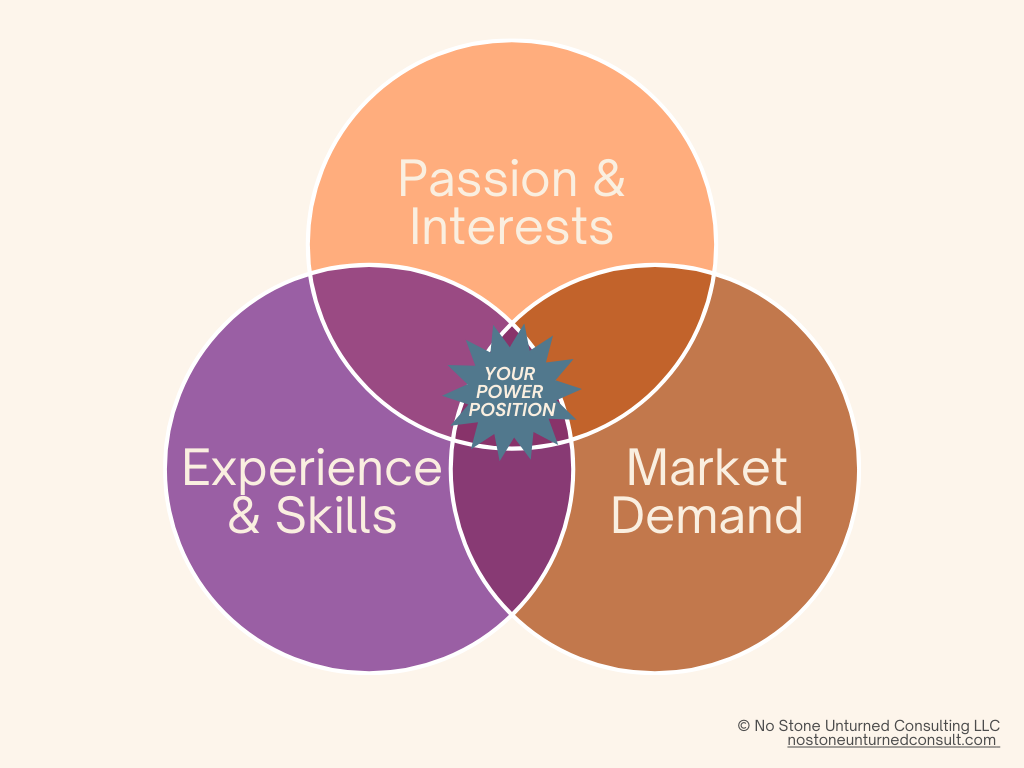
It sits at the intersection of:
What you care about (Passion & Interests)
What you’re skilled at and willing to keep doing (Skills & Experience)
What the market pays for (Market Demand)
When all three are present and overlapping, you have a clear direction. Your search has a center of gravity. You can evaluate opportunities against something specific instead of asking, role by role, “Could I do this?”
The problem is whether you should. The Power Position helps you figure that out.
Most mid-career women have at least one circle that they’re stuck on. That’s why the work isn’t entirely about discovering something new. It’s also about finding out how to expand your circles to maximize your Power Position.
Why the Overlap is Small
As you answer the questions, you may get stuck on “should dos,” identify skill gaps, or realize more research is needed. Here’s what that might look like:
Passion circle: You build toward something practical and viable that doesn’t align with what energizes you. You land the role and six months in, the dread returns. This is the hardest to identify and name, because the role looks fine on paper.
Skills circle: You chase something you’re not yet positioned to do. The gap between where you are and where you want to be is real, and you haven’t accounted for what it will take to close it.
Market Demand circle: You invest in a direction with limited opportunities at your level of seniority. You network, apply, and optimize, but nothing converts. Your skills and enthusiasm aren’t enough to create jobs that don’t exist at the rate you need them to exist.
The strategies to fix these challenges are different. But you cannot assess which one(s) you are facing without working through the three circles deliberately.
Why this is harder than it sounds
Most career advice skips this step. It assumes you already know what you want and you just need help getting it. It hands you a resume template, a networking script, or a LinkedIn optimization checklist.
Those tools are useful, but after you’ve addressed your clarity problem.
Working through the Power Position requires answering questions that don’t have polished, professional answers.
What do you care about, separate from what you’ve decided or been told to care about?
What are you willing to keep doing, separate from what you’re good at?
What is the real, verifiable demand for the direction you’re considering?
These questions don’t fit on a cover letter. They’re the questions you have to answer before the cover letter has anything worth saying.
Where to start
I built a worksheet that walks you through the three circles, five questions each, with a synthesis section at the end. It surfaces where your thinking is clear and where it’s built on assumptions you haven’t tested.
Download the Power Position Exercise here.
Over the next three weeks, I’m going deeper into each circle: where mid-career women get stuck, and what to do when the overlap is smaller than you hoped.
This exercise helps you frame what’s next so that when you jump into tactics-mode — resume, networking, applications — it has a real chance of working.
Which of the three circles do you think will be hardest for you to answer? That suspicion is usually right, and it’s where the real work is.
A succinct strategy for positioning - looking forward to the worksheet.